Artologium
The public life of imagesFour ways an image keeps living

Images enter the world.

What happens after an image
leaves its maker?

· · 1896
Image & source

Image record / Public Domain

JOB

Maker
Alphonse Mucha
Date
1896
Collection
Wikimedia Commons
Accession
Mucha-job.jpg
Credit
Faithful reproduction of a public-domain print; source recorded by Wikimedia Commons.
Rights
Public Domain

Resized; thumbnail details are labeled. The full image remains available.

70years later

Another audience.

& ·
Image & source

Image record / In copyright · editorial reference

Jim Kweskin Jug Band, Avalon Ballroom

Maker
Alton Kelley and Stanley Mouse
Date
1966
Collection
Georgetown University Library
Accession
2015.49.7 · Third printing
Credit
Georgetown University Library, Fairchild Endowment Fund purchase, 2015.49.7 (third printing). Artwork copyright is stated by the Phillips Collection as © 1966, 1984, 1994 Rhino Entertainment Company. All rights reserved.
Rights
In copyright · editorial reference

Complete 600-pixel library reference image, JPEG recompressed. No recoloring. Displayed as an editorial reference alongside analysis of the adaptation.

Open source record ↗

01 / Images borrowed

The poster that came back psychedelic.

Seventy years later, a figure made to sell cigarette papers returned on a San Francisco concert poster. The tilted head and lifted cigarette remain; green hair and concert lettering give the familiar figure a different invitation.

Trace the transformation
01 / The passage from advertisement to concertRead the story & sources

Documented adaptation

The figure travels.
The invitation changes.

’s 1896 advertised cigarette papers. In 1966, and adapted its woman for the . The Phillips Collection’s exhibition text records Mouse finding Mucha through books in a public library.

Our close reading: follow the tilted head, the cigarette and the coils of hair. The borrowed figure stays recognizable; the colour and concert lettering redirect her toward a different audience.

What establishes the connection?

  1. The Phillips Collection, Timeless Mucha exhibition text, PDF p. 41 — the library account and the adapted motif. Object checklist: PDF p. 13.
  2. Minneapolis Institute of Art, object 2019.59.30 — identifies the borrowed figure and interprets its countercultural context.

These sources document an adaptation and its context. They do not establish that this single poster changed society on its own.

Follow another documented passage →

The later poster adapts the figure from JOB. The library account documents a route of discovery; it does not identify the particular book Mouse used.

Read the full comparison: the figure, the colour and the audience →

02 / Colour, art and everyday life

From canvas to clothing.Worn.

Follow the painted line into the seam.

Read the full investigation →
· · 1965Photo: · CC BY 2.0Silhouette crop · open for the full photograph
Image & source

Image record / CC BY 2.0 (photograph)

Mondrian dress and Composition in Red, Blue and Black II

Maker
Yves Saint Laurent and Piet Mondrian; photograph by Jean-Pierre Dalbéra
Date
Dress: 1965 · Painting: 1937 · Photograph: 2022
Collection
Centre Pompidou display / Jean-Pierre Dalbéra
Accession
Flickr 51884007615
Credit
Photograph © Jean-Pierre Dalbéra (dalbera), CC BY 2.0, via Wikimedia Commons. Shown cropped around the dress; full photograph available. License covers the photograph, not rights in the depicted designs.
Rights
CC BY 2.0 (photograph)

Resized full photograph plus a labeled crop around the dress. The fashion spread uses a CSS silhouette crop to exclude the surrounding display background. No retouching or colour changes; full photograph available.

Page presentation: a cropped detail. The complete source image is shown above; its file has not been cropped for this display.

What the eye reads as a line can become a way of joining.

· · 1921
Image & source

Image record / CC0

Lozenge Composition with Yellow, Black, Blue, Red, and Gray

Maker
Piet Mondrian Dutch, 1872–1944
Date
1921
Collection
The Art Institute of Chicago
Accession
1957.307
Credit
Gift of Edgar Kaufmann, Jr.
Rights
CC0

Unchanged copy of the institution’s verified web image; smaller responsive JPEGs are resized derivatives. Full-resolution image remains linked to the institution.

A visual comparison from the collection; not identified as the dress’s exact source painting.

What does a painting become on a body?Read the story & sources

Documented design reference

The line does the work.

For his fall/winter 1965–66 collection, translated’s geometric vocabulary into dresses. The Met explains that individual jersey blocks were pieced together, with shaping concealed in the grid of seams. This was construction as well as colour.

Our close reading: the eye reads a flat composition, while the seams make room for a moving body. A painting’s divisions acquire a practical job.

Source & limits

The Met, Dress, C.I.69.23 documents the collection and its dressmaking. The photograph shown here is a different museum display of a Mondrian dress, photographed at the Centre Pompidou in 2022.

The Chicago painting provides a concrete comparison of Mondrian’s visual language. This pairing does not claim that this particular canvas was copied.

Look closely at the painting →

Saint Laurent’s reference to Mondrian is documented. Chicago’s 1921 Lozenge Composition is a visual comparison, not an established source canvas for this dress.

Read the full comparison: a painted division becomes construction →

A new way into Afterlives / Pattern studies

Cloth pretending
to be cloth.

How do you print the appearance of something woven?

Follow the imitation

Cooper Hewitt identifies a stencil imitating warp ikat. No exact source cloth is identified.

Japan · Geometric Pattern Imitating Warp Ikat (Kasuri)
Mid-18th–early-19th century · Cooper Hewitt · CC0

Geometric Pattern Imitating Warp Ikat (Kasuri)

GEOMETRIC PATTERN IMITATING WARP IKAT (KASURI)

Maker unrecorded · mid 18th - early 19th century
Cooper Hewitt, Smithsonian Design Museum · 1976-103-110
Gift of Helen Snyder · CC0

Complete source image. No reconstruction or pixel alterations.

Institution record ↗License statement ↗

03 / Patterns across places

A pattern travels.
Its name changes.

How did this pattern acquire a Scottish name?

Follow the pattern →
Kashmir · · c. 1850–70Detail · open for the full object
Image & source

Image record / CC0

Square Shawl

Maker
Maker unrecorded
Date
c. 1850–70
Collection
Cleveland Museum of Art
Accession
1940.600
Credit
Bequest of James Parmelee
Rights
CC0

Resized web image. Detail crops are labeled; the full image remains available.

Page presentation: a cropped detail. The complete source image is shown above; its file has not been cropped for this display.

Probably French · · 1860–75Detail · open for the full object
Image & source

Image record / CC0

Shawl

Maker
Maker unrecorded; probably French
Date
1860–75
Collection
The Metropolitan Museum of Art
Accession
2009.300.3373
Credit
Brooklyn Museum Costume Collection at The Metropolitan Museum of Art, Gift of the Brooklyn Museum, 2009; Gift of Dr. and Mrs. Charles Parera, 1984
Rights
CC0

Resized; detail crops are labeled and the full image remains accessible.

Page presentation: a cropped detail. The complete source image is shown above; its file has not been cropped for this display.

Whose name survives the journey?Read the story & sources

A history of circulation

Trade, imitation,
and an uneven exchange.

“Paisley” names a Scottish manufacturing town, not the pattern’s place of invention. Suchitra Choudhury traces how imported Indian shawls became desirable in Britain, and how Edinburgh, Norwich and Paisley manufacturers produced imitations.

Her account also describes exchanges with French makers and changes in Indian production for foreign buyers. Colonial power shaped this circulation. A neat one-way arrow would leave too much out.

Source & limits

Suchitra Choudhury, A long way from home: the Paisley pattern and India, V&A Dundee.

The Cleveland and Met shawls are comparison objects. No direct copying relationship between these two objects is established. The Met’s attribution remains “probably French.”

Our question: what becomes harder to see when a maker’s tradition is known by another place’s name?

Artologium compares two nineteenth-century shawls with overlapping dates. No object-to-object copying is established, and the Met retains the attribution probably French.

Read the full comparison: two shawls, trade and a familiar name →

04 / From textile to interaction

A Victorian textile
becomes a game.

In 2014, turned ’s into a world a player could move through.

Explore the adaptation →

An Artologium close-looking study

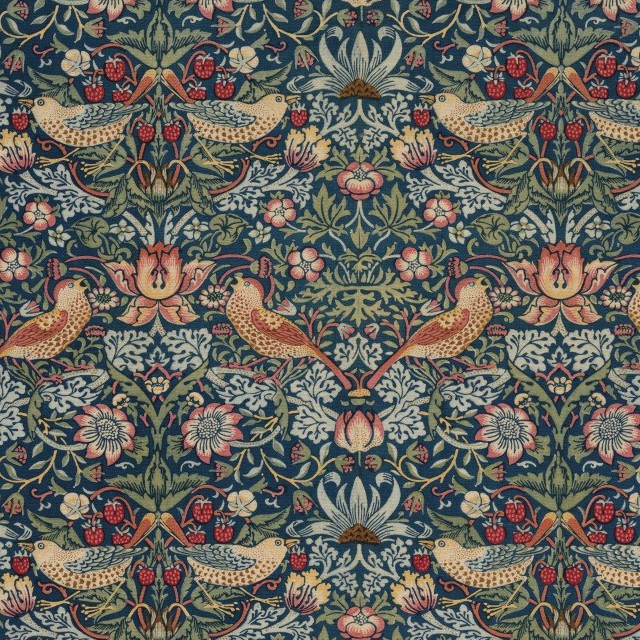
Detail of birds and strawberries from William Morris’s Strawberry Thief, printed about 1936. Cleveland Museum of Art, CC0.
Follow
a bird.
From looking
to moving

A character, already waiting. Our close reading: begin with the bird’s eye and the curve of its body. A small figure gives your eye somewhere to enter.

Cleveland Museum of Art · CC0 · annotated detail.
Our study, distinct from Sophia George’s game.

Try the pattern in motion

An Artologium experiment

Motion is off to respect your preference. Change the repeats to explore. Sample from Cleveland’s c. 1936 printing; our experiment is distinct from Sophia George’s game.

· Design: 1883 · this printing: c. 1936
Image & source

Image record / CC0

Strawberry Thief

Maker
William Morris (British, 1834–1896)
Date
c 1936
Collection
Cleveland Museum of Art
Accession
1937.696
Credit
Gift of Mrs. Henry Chisholm
Rights
CC0

Resized full photograph. A square detail crop is tiled in the separate repeat study; it does not reconstruct the original repeat unit. The complete sample remains available.

From something to look at, to something to doRead the story & sources

Documented adaptation

A pattern gains time.

developed Strawberry Thief following her residency at the V&A. Its launch on 24 October 2014 is recorded by curator Dawn Hoskin. The game lets a player guide a bird through the design, bringing a drawn pattern into colour.

Our close reading: the pattern becomes an unfolding experience. The player’s movement changes when and where an image appears.

Sources & a separate experiment

Dawn Hoskin, More Strawberry Thieves?, V&A, 24 October 2014. Laura Southall’s August 2014 gameplay preview explains the mechanics and credits the collaborators.

Our motif and repeat studies above are original Artologium interactions using Cleveland’s CC0 textile photograph. It is not a playable copy or a screenshot of George’s game. Tiling the photograph is an experiment, not a reconstruction of Morris’s seamless repeat.

Try another studio experiment →

The V&A documents George’s game and its inspiration. Cleveland’s later textile printing is our comparison image; Artologium’s study is an independent exercise, not the game.

Read the full comparison: a pattern acquires movement and time →

Find your next obsession.

1,553 works · 6 museum collections

Browse all works →
· 1896Detail · open for the full object
Image & source

Image record / Public Domain

JOB

Maker
Alphonse Mucha
Date
1896
Collection
Wikimedia Commons
Accession
Mucha-job.jpg
Credit
Faithful reproduction of a public-domain print; source recorded by Wikimedia Commons.
Rights
Public Domain

Resized; thumbnail details are labeled. The full image remains available.

Page presentation: a cropped detail. The complete source image is shown above; its file has not been cropped for this display.

Posters & print

An image made to circulate. Explore prints, their surfaces and their purposes.

& · Detail · open for the full object
Image & source

Image record / In copyright · editorial reference

Jim Kweskin Jug Band, Avalon Ballroom

Maker
Alton Kelley and Stanley Mouse
Date
1966
Collection
Georgetown University Library
Accession
2015.49.7 · Third printing
Credit
Georgetown University Library, Fairchild Endowment Fund purchase, 2015.49.7 (third printing). Artwork copyright is stated by the Phillips Collection as © 1966, 1984, 1994 Rhino Entertainment Company. All rights reserved.
Rights
In copyright · editorial reference

Complete 600-pixel library reference image, JPEG recompressed. No recoloring. Displayed as an editorial reference alongside analysis of the adaptation.

Page presentation: a cropped detail. The complete source image is shown above; its file has not been cropped for this display.

Open source record ↗

· 1921Detail · open for the full object
Image & source

Image record / CC0

Lozenge Composition with Yellow, Black, Blue, Red, and Gray

Maker
Piet Mondrian Dutch, 1872–1944
Date
1921
Collection
The Art Institute of Chicago
Accession
1957.307
Credit
Gift of Edgar Kaufmann, Jr.
Rights
CC0

Unchanged copy of the institution’s verified web image; smaller responsive JPEGs are resized derivatives. Full-resolution image remains linked to the institution.

Page presentation: a cropped detail. The complete source image is shown above; its file has not been cropped for this display.

Colour & clothing

Look at what happens when a composition has a body to dress.

· Dress: 1965 · Painting: 1937 · Photograph: 2022Detail · open for the full object
Image & source

Image record / CC BY 2.0 (photograph)

Mondrian dress and Composition in Red, Blue and Black II

Maker
Yves Saint Laurent and Piet Mondrian; photograph by Jean-Pierre Dalbéra
Date
Dress: 1965 · Painting: 1937 · Photograph: 2022
Collection
Centre Pompidou display / Jean-Pierre Dalbéra
Accession
Flickr 51884007615
Credit
Photograph © Jean-Pierre Dalbéra (dalbera), CC BY 2.0, via Wikimedia Commons. Shown cropped around the dress; full photograph available. License covers the photograph, not rights in the depicted designs.
Rights
CC BY 2.0 (photograph)

Resized full photograph plus a labeled crop around the dress. The fashion spread uses a CSS silhouette crop to exclude the surrounding display background. No retouching or colour changes; full photograph available.

Page presentation: a cropped detail. The complete source image is shown above; its file has not been cropped for this display.

· c 1936Detail · open for the full object
Image & source

Image record / CC0

Strawberry Thief

Maker
William Morris (British, 1834–1896)
Date
c 1936
Collection
Cleveland Museum of Art
Accession
1937.696
Credit
Gift of Mrs. Henry Chisholm
Rights
CC0

Resized full photograph. A square detail crop is tiled in the separate repeat study; it does not reconstruct the original repeat unit. The complete sample remains available.

Page presentation: a cropped detail. The complete source image is shown above; its file has not been cropped for this display.

Ornament & pattern

Follow a line into the woven world. Browse textiles across collections.

· c. 1850–70Detail · open for the full object
Image & source

Image record / CC0

Square Shawl

Maker
Maker unrecorded
Date
c. 1850–70
Collection
Cleveland Museum of Art
Accession
1940.600
Credit
Bequest of James Parmelee
Rights
CC0

Resized web image. Detail crops are labeled; the full image remains available.

Page presentation: a cropped detail. The complete source image is shown above; its file has not been cropped for this display.

Our editorial approach

Every story
has a source.

Objects, records, letters, research. We distinguish documented connections from the questions we bring to them.

How we work →

Research and close readings developed with AI assistance; independent editorial review is pending.

A line worth following. Detail from ’s .Detail · open for the full object
Image & source

Image record / Public Domain

JOB

Maker
Alphonse Mucha
Date
1896
Collection
Wikimedia Commons
Accession
Mucha-job.jpg
Credit
Faithful reproduction of a public-domain print; source recorded by Wikimedia Commons.
Rights
Public Domain

Resized; thumbnail details are labeled. The full image remains available.

Page presentation: a cropped detail. The complete source image is shown above; its file has not been cropped for this display.

Your eye, your collection

What would you
carry forward?

Keep a work. Put two side by side. Follow a connection that only you would have noticed.

Start a personal collection →Visit the opening exhibition ↗