Afterlives / Interactive passage
An image made of feathers.
What changes when a printed scene is remade in iridescence?
Read through the records
Model
Material
Address
The original works remain with their source records. Follow the links below to view them alongside the argument.
An interactive passage / Select a stop
Move from model to material to address.
Model
A print with an unresolved identity
The source supports a European print relationship while leaving the exact print unidentified. This space remains a document reference.
European print of the Mass of Saint Gregory
Getty curator Kim Richter describes the 1539 Mass of Saint Gregory featherwork as based on a European print, probably Netherlandish.
The interview does not establish the exact source print. No convenient surviving engraving is presented as that source.
Inspect this connection ↓The link preserves this stop and research version. Its social image represents the whole investigation.
Read the complete passage
Model · A print with an unresolved identity
The source supports a European print relationship while leaving the exact print unidentified. This space remains a document reference.
Material · Nahua featherwork
The material and practice matter to what the image becomes. Open the holding-image reference through the Getty transcript to examine the work.
Address · An intended recipient
The inscription supplies a named commissioner and papal recipient in the curator’s reading. It records an address, not a measured effect.
01 / Close reading
A scene about transformation is made in changing light.
The scene concerns Gregory’s Mass and a miraculous appearance of Christ. Getty curator Kim Richter places that Christian subject in a work made through Nahua featherworking. A scene about transformation has itself crossed into a medium whose light changes with the material.
Read the image at the source alongside the account of its feathers. Their iridescence is part of the work’s material encounter, while a fixed screen reproduction can show only one view. The proposed European print supplies a compositional relationship; it does not exhaust what the makers brought to the scene.
02 / Historical account
The intended gift carries an argument about its makers.
Richter connects the 1539 work to Pope Paul III’s 1537 declaration against Indigenous enslavement and names Huanitzin through the inscription. In her account, the intended gift’s sophistication matters to an argument about Indigenous rationality. This was a claim made within colonial violence, not evidence that the declaration ended enslavement.
The commissioner, featherworkers, school and intended recipient belong to the passage alongside the proposed print. The inscription helps establish an intended address; the cited accounts do not establish arrival or the pope’s response. The unresolved destination should not obscure the political purpose attributed to its making.
Keep the identities distinct
Works, people & carriers.
document
European print of the Mass of Saint Gregory
Before 1539
Probably Netherlandish in the curator’s account; exact print not established here.
Open the source record ↗work
Nahua artists, Mass of Saint Gregory
1539
Musée des Amériques–Auch, 986.1.1; image linked externally, not reproduced.
Open the source record ↗person
Don Diego de Alvarado Huanitzin
1539 commission
Indigenous governor identified by the curator through the inscription.
Open the source record ↗event
Intended gift for Pope Paul III
1539
Intention and receipt remain distinct.
Open the source record ↗The research stays attached
How we know.
Source verification and prose revised with AI assistance. Independent specialist review remains pending.
Editorial review · 2026-10-17
A scene of transformation becomes an intended gift with a political address.
Checked 2026-10-17 · an-image-made-of-feathers.3
Download the research record ↓attributedGetty curator Kim Richter describes the 1539 Mass of Saint Gregory featherwork as based on a European print, probably Netherlandish.
Relationship: adaptation
European print of the Mass of Saint Gregory Nahua artists, Mass of Saint Gregory
The limit: The interview does not establish the exact source print. No convenient surviving engraving is presented as that source.
- Golden Kingdoms: Luxury Arts in the Ancient Americas ↗
Transcript exchange beginning 'Do we know what the imagery is based on'
attributedGetty’s account identifies the featherwork as a gift intended for Pope Paul III and names Don Diego de Alvarado Huanitzin as commissioner through its inscription.
Relationship: catalogue fact
Nahua artists, Mass of Saint Gregory Intended gift for Pope Paul III
The limit: The cited interpretation and English rendering of the inscription are attributed to the curator. The gift’s intention does not prove receipt or a particular response.
- Golden Kingdoms, stop 1565: Mass of Saint Gregory ↗
Audio transcript, narrator and Kim Richter passages
- Golden Kingdoms: Luxury Arts in the Ancient Americas ↗
Transcript exchange beginning 'Do we know what the imagery is based on'
attributedGetty curator Kim Richter interprets the intended 1539 gift in relation to Pope Paul III’s declaration against Indigenous enslavement two years earlier.
Relationship: response
The limit: The purpose is a curator-attributed interpretation. The declaration is not treated as ending enslavement, and the gift’s receipt or response is not established.
- Golden Kingdoms, stop 1565: Mass of Saint Gregory ↗
Kim Richter’s passage beginning It was created in 1539
- Golden Kingdoms: Luxury Arts in the Ancient Americas ↗
Exchange about the commission and the papal declaration
documentedGetty’s audio guide identifies the 1539 work as a feather mosaic using quetzal, cotinga, hummingbird and macaw feathers.
Relationship: catalogue fact
The limit: This identifies the work through the institutional account. A screen image does not reproduce the material’s changing iridescence.
- Golden Kingdoms, stop 1565: Mass of Saint Gregory ↗
Opening narrator passage on mosaic materials and Kim Richter’s 1539 dating
Source ledger · 2 records
scholarship · en
Golden Kingdoms, stop 1565: Mass of Saint Gregory ↗
Getty; commentary by Kim Richter
Checked 2026-10-17 · Source text. Relevant source text and its stated object, date or license fields were inspected; this does not imply independent specialist review.
Locate: Audio transcript, narrator and Kim Richter passages
Supports: The 1539 Nahua feather mosaic's materials, inscription and papal-gift context.
Limit: Religious and political interpretation is attributed to the curator. A gift's intention does not establish the pope's reception; image credit is restricted.
scholarship · en
Golden Kingdoms: Luxury Arts in the Ancient Americas ↗
Getty Art + Ideas; Kim Richter
Checked 2026-10-17 · Source text. Relevant source text and its stated object, date or license fields were inspected; this does not imply independent specialist review.
Locate: Transcript exchange beginning 'Do we know what the imagery is based on'
Supports: The curator describes a European print, probably Netherlandish, and identifies the commissioner through the inscription.
Limit: The print's specific identity is not established by this interview. English translation of the Latin inscription is the speaker's; no new translation is claimed.
Public life: reach, response, consequence
Reach. Getty identifies an intended papal gift; the cited accounts do not prove delivery or receipt.
Response. Richter interprets the gift through Indigenous rationality, colonial conditions and the papal context. This is attributed curatorial interpretation.
Consequence. The inscription and making support a political address; the pope’s response or a wider change caused by this object is not established.
Versions & corrections
- an-image-made-of-feathers.1 · 2026-10-17
First source-checked review edition. Historical claims and original readings are distinguished; image permissions are recorded separately.
- an-image-made-of-feathers.2 · 2026-10-17
Checked Getty’s material, inscription and probably Netherlandish print account. Made the curator-attributed papal and colonial context explicit while avoiding a claim that a declaration ended enslavement. Kept the exact model, delivery and recipient response unresolved.
- an-image-made-of-feathers.3 · 2026-10-17
Checked Getty’s material, inscription and probably Netherlandish print account. Made the curator-attributed papal and colonial context explicit while avoiding a claim that a declaration ended enslavement. Kept the exact model, delivery and recipient response unresolved. Gave the material stop its own featherwork evidence instead of using the proposed-print claim.
Historical source assertions, editorial readings and image decisions are separate. A revision changes the research version and regenerates dependent summaries and exports.
Suggest a correction →The story branches
Carry a question forward.
These are editorial reading suggestions. Each investigation makes its own argument.
Follow translation into another setting.
A saint changes languages.
What happens when a printed figure enters another painter’s world?
A connection attributed in the research
Follow the passageCompare a different kind of transformation.
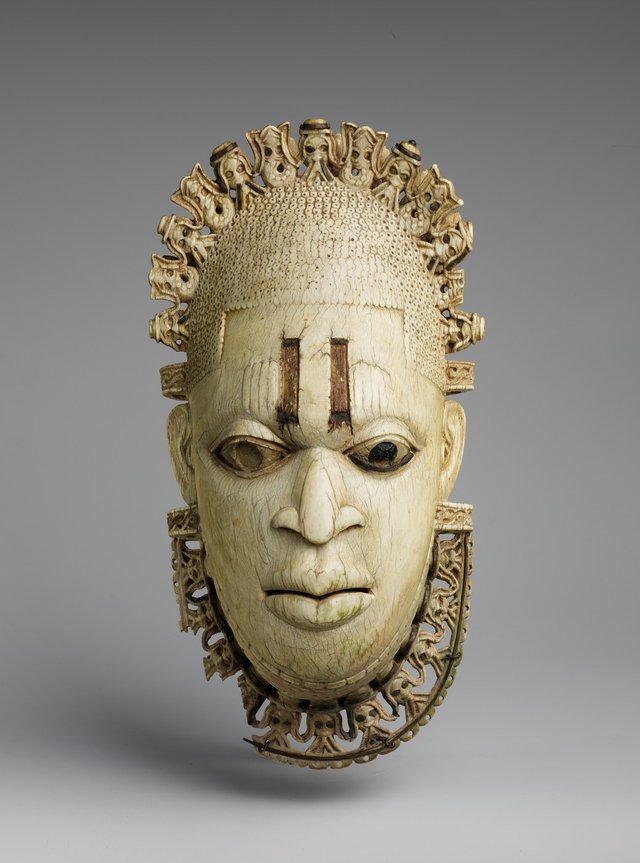
Pendant mask of Ìyọ́bà Idià
- Maker
- Ìgbèsànmwà (ivory- and wood- carving guild) artists
- Date
- 16th century
- Collection
- The Metropolitan Museum of Art
- Accession
- 1978.412.323
- Credit
- The Michael C. Rockefeller Memorial Collection, Gift of Nelson A. Rockefeller, 1972
- Rights
- CC0
An emblem and an absence.
A documented connection
Open the connection study