Afterlives / Visual essay
A pattern negotiates a market.
Who is adapting to whom when a textile is made for export?
Read through the records
Making
Design
Market
The original works remain with their source records. Follow the links below to view them alongside the argument.
A way into this story
Hold making, designing and buying in separate columns.
Making
Knowledge resides with makers
A market destination does not relocate the skill required to make a textile. The broad trade history begins before the European demand in this story.
Inspect the evidence ↓Design
A reference returns differently
The catalogue connects a painted cotton design to woven silk patterns. A relationship can cross both place and process.
Inspect the evidence ↓Market
Demand meets restriction
The restrictions described by the museum concern the wider textile trade. This curtain is a witness within that context, not its sole cause.
Inspect the evidence ↓
01 / Historical account
A bed furnishing carries a design between processes.
The Met identifies this curtain as one of four surviving examples and proposes that it belonged to a set of bed furnishings. It describes ribbon-like forms and stylized flowers related to European lace-patterned silks of the 1720s. The specific encounter is an arrangement moving from woven silk into painted and dyed cotton.
That reverses a simple account of an Indian motif travelling west. The V&A places Indian textiles within much older export networks; this object belongs to a later negotiation with European markets. The records give us a design relationship and a probable use, while leaving the people who specified this curtain unnamed.
02 / Close reading
Read the description without supplying a substitute image.
The medium is cotton, worked with painted resist, mordant and dye. The catalogue’s description of undulating ribbon-like forms invites a question about continuity: how might the look of a woven band be carried by colour laid into a different material?
The source record has no available image, so that question remains a document-led reading. We can name the described features and compare processes; we cannot inspect this curtain’s exact colours or use a different floral fabric as evidence of its appearance.
03 / Open question
Desire and restriction appear in the same record.
The Met places chintz within a history of British and French restrictions intended to protect domestic production, alongside continuing re-export. That is evidence of conflict around a textile category. The account does not establish that this curtain crossed a border illicitly.
A furnishing made for a market can therefore belong to a wider argument about what that market should be allowed to buy. The individual object’s design, probable household function and category’s economic reception sit at different scales. Keeping those scales visible makes the negotiation more specific.
Keep the identities distinct
Works, people & carriers.
tradition
Indian textile export networks
Longstanding trade before European expansion
Open the source record ↗tradition
European lace-patterned woven silks
1720s
Open the source record ↗work
Chintz curtain for a European market
1720–40
Probably Coromandel Coast; no image available in the inspected record.
Open the source record ↗The research stays attached
How we know.
Source verification and prose revised with AI assistance. Independent specialist review remains pending.
Editorial review · 2026-10-17
A proposed bed furnishing adapts a woven-silk arrangement into worked cotton.
Checked 2026-10-17 · a-pattern-negotiates-a-market.2
Download the research record ↓attributedThe Met relates the design of its Indian chintz curtain to European lace-patterned woven silks of the 1720s.
Relationship: attributed reference
European lace-patterned woven silks Chintz curtain for a European market
The limit: No exact silk or design instruction is identified. The place of manufacture is qualified as probable.
- Chintz curtain, 1720–40 ↗
Opening commentary, especially lace-patterned silks and domestic-use restrictions
documentedThe V&A describes Indian textile exports across Asian, African and Mediterranean markets before the arrival of European maritime merchants.
Relationship: circulation
Indian textile export networks Chintz curtain for a European market
The limit: A broad trade history does not establish the itinerary of this curtain.
- Indian textiles ↗
International trade and European trade sections
documentedThe Met describes British and French domestic-use restrictions on chintz and the continuing possibility of re-export in the British East India Company trade.
Relationship: reception
The limit: This is historical context for a textile category, not evidence that this particular curtain caused legislation or followed a specific illicit route.
- Chintz curtain, 1720–40 ↗
Opening commentary, especially lace-patterned silks and domestic-use restrictions
attributedThe Met describes the curtain as one of four surviving and most likely part of bed furnishings.
Relationship: catalogue fact
The limit: The proposed use remains qualified; no original household or commission is identified.
- Chintz curtain, 1720–40 ↗
Second commentary paragraph, proposed function and surviving group
Source ledger · 2 records
institutional account · en
Indian textiles ↗
Victoria and Albert Museum
Checked 2026-10-17 · Source text. Relevant source text and its stated object, date or license fields were inspected; this does not imply independent specialist review.
Locate: International trade and European trade sections
Supports: Longstanding Indian textile exports across Asia, Africa and the Mediterranean; later European trade and exploitation of weavers.
Limit: A broad history; it does not establish the route of every surviving textile. This page alone does not identify individual makers.
object record · en
Chintz curtain, 1720–40 ↗
The Metropolitan Museum of Art
Checked 2026-10-17 · Source text. Relevant institutional record text checked through the research browser; direct scripted requests were rate-limited.
Locate: Opening commentary, especially lace-patterned silks and domestic-use restrictions
Supports: The curtain's design relates to European woven silks; the record describes restrictions and re-export in the wider chintz trade.
Limit: Probably Coromandel Coast; likely bed furnishings. The record has no image available at the check date. No precise route for this object is established.
Public life: reach, response, consequence
Reach. Sources describe export markets and a curtain probably used in bed furnishings; its original household is unidentified.
Response. The Met describes British and French restrictions on the wider chintz category, rather than a reaction to this single curtain.
Consequence. The record supports economic conflict around a class of goods and a cross-process design reference. It does not establish this object causing policy.
Versions & corrections
- a-pattern-negotiates-a-market.1 · 2026-10-17
First source-checked review edition. Historical claims and original readings are distinguished; image permissions are recorded separately.
- a-pattern-negotiates-a-market.2 · 2026-10-17
Checked the four-surviving-curtains account and qualified bed-furnishing function. Made ribbon-like forms and the cotton process concrete without inventing an absent image. Kept trade restrictions at category scale and avoided an illicit itinerary for the curtain.
Historical source assertions, editorial readings and image decisions are separate. A revision changes the research version and regenerates dependent summaries and exports.
Suggest a correction →The story branches
Carry a question forward.
These are editorial reading suggestions. Each investigation makes its own argument.
Follow textiles into another setting.
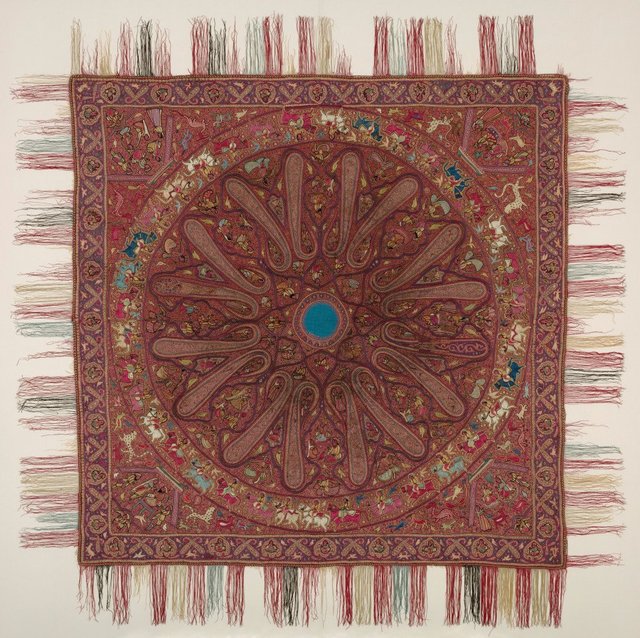
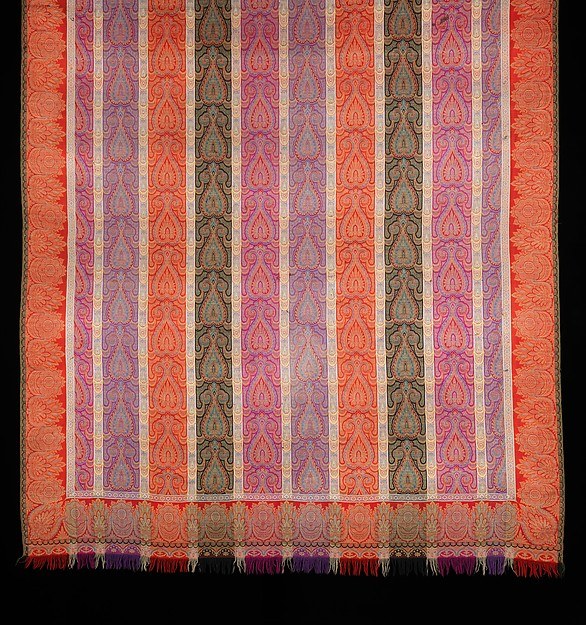
Square Shawl
- Maker
- Maker unrecorded
- Date
- c. 1850–70
- Collection
- Cleveland Museum of Art
- Accession
- 1940.600
- Credit
- Bequest of James Parmelee
- Rights
- CC0
Shawl
- Maker
- Maker unrecorded; probably French
- Date
- 1860–75
- Collection
- The Metropolitan Museum of Art
- Accession
- 2009.300.3373
- Credit
- Brooklyn Museum Costume Collection at The Metropolitan Museum of Art, Gift of the Brooklyn Museum, 2009; Gift of Dr. and Mrs. Charles Parera, 1984
- Rights
- CC0
A pattern travels. A name stays.
An Artologium visual comparison
Read the visual essayAnother case of attributed reference.
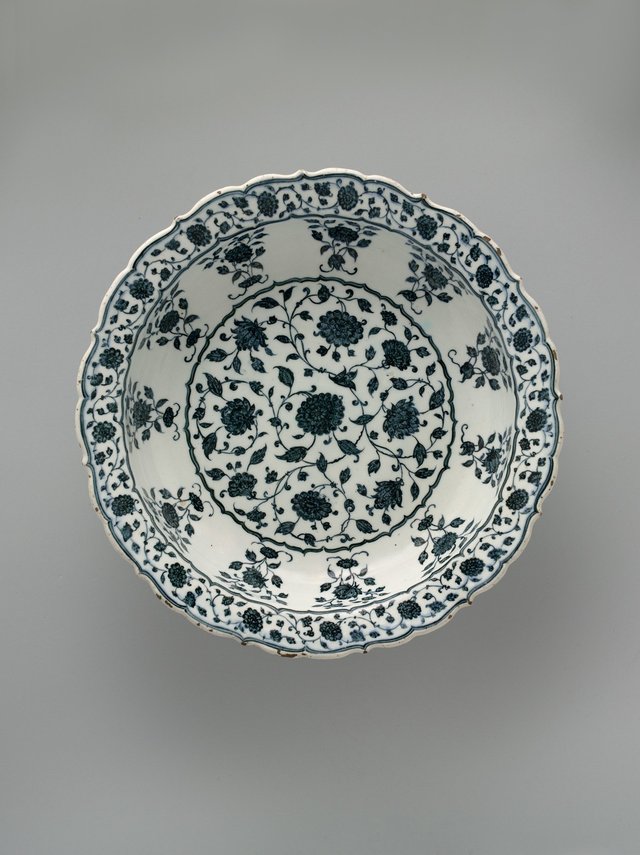
Footed Dish with Foliate Rim in Imitation of Chinese Porcelain
- Maker
- Maker unrecorded
- Date
- ca. 1570–80
- Collection
- The Metropolitan Museum of Art
- Accession
- 66.4.2
- Credit
- Harris Brisbane Dick Fund, 1966
- Rights
- CC0
A dish translates porcelain.
A connection identified by The Met
Read the visual essay