Afterlives / Visual essay
An animal made of reports.
How can an image become authoritative without an eyewitness?
A way into this story
Separate seeing an animal from seeing its image.
Report
Knowledge at a distance
A report can make an animal available to an artist without bringing the animal into the studio.
Inspect the evidence ↓Print
A surface full of decisions
Inspect the armor-like divisions, dots and folds in the woodcut. These are visible marks; their visual confidence does not prove direct observation.
Inspect the evidence ↓Object
An image gains a body
The Louvre’s attribution points to a later porcelain adaptation. The catalogue’s own ambiguities remain part of the evidence.
Inspect the evidence ↓
01 / Close reading
The armour is convincing before it is convincing evidence.
Follow the plate-like divisions across the animal’s back, then the rings around its legs and the small spiral above its shoulder. The woodcut supplies an abundance of distinct marks. The eye can read that specificity as knowledge before asking where the knowledge came from.
The British Museum states that Dürer did not see the animal and proposes a newsletter as a likely source for his drawing. The animal in the image is therefore also a problem of translation: how can a verbal description become a body with surfaces the reader can inspect?
02 / Historical account
The report and the porcelain are different passages.
The British Museum names the proposed newsletter intermediary and links the drawing to the woodcut. The Met impression shown here is a surviving example of the printed design, not the report or a record of the artist observing a live rhinoceros.
The Louvre’s porcelain entry supplies a later connection, describing a Kändler model after Dürer. Its attribution fields and Chinese-porcelain wording do not fully agree, so manufacture and date remain unresolved here. What can be followed is the catalogue’s named design relationship, not an unbroken sequence of copies from this particular sheet.
Keep the identities distinct
Works, people & carriers.
document
Account of the rhinoceros in Lisbon
1515
A newsletter is a likely intermediary, according to the British Museum.
Open the source record ↗design
Dürer’s rhinoceros image
1515
Open the source record ↗work
The Rhinoceros, Met impression
1515 design
Comparison impression; not established as the porcelain model’s source.
Open the source record ↗work
Rhinocéros, Louvre OA 8066
Manufacture date unestablished here
Model described as Kändler after Dürer; catalogue wording remains qualified.
Open the source record ↗The research stays attached
How we know.
Source verification and prose revised with AI assistance. Independent specialist review remains pending.
Editorial review · 2026-10-17
Abundant visual detail can feel authoritative before its source is known.
Checked 2026-10-17 · an-animal-made-of-reports.2
Download the research record ↓attributedThe British Museum states that Dürer did not see the animal and proposes a newsletter account from Lisbon as a likely source for his drawing.
Relationship: transmission
Account of the rhinoceros in Lisbon Dürer’s rhinoceros image
The limit: The intermediary is qualified as likely. The surviving Met print is a separate witness to the design.
- Dürer's rhinoceros drawing, SL,5218.161 ↗
Curator's comments on Ferdinand's report and Dürer's lack of direct observation
attributedThe Louvre describes its porcelain rhinoceros model as Kändler after Dürer.
Relationship: adaptation
Dürer’s rhinoceros image Rhinocéros, Louvre OA 8066
The limit: The record does not establish the source impression or a manufacture date here; its Chinese-porcelain wording alongside Meissen attribution needs further investigation.
- Rhinocéros, OA 8066 ↗
Description / Décor; Artiste / Auteur; Caractéristiques matérielles
Source ledger · 3 records
object record · en
Dürer's rhinoceros drawing, SL,5218.161 ↗
British Museum
Checked 2026-10-17 · Indexed source text. Relevant indexed primary-source text checked. Direct scripted access was blocked, empty or incomplete; this is not recorded as a successful full-page retrieval.
Locate: Curator's comments on Ferdinand's report and Dürer's lack of direct observation
Supports: Dürer did not see the animal; a newsletter account is proposed as a likely intermediary.
Limit: The likely transmission of the report is not an identified surviving sketch used at the moment of drawing.
object record · fr
Rhinocéros, OA 8066 ↗
Musée du Louvre
Checked 2026-10-17 · Source text. Relevant source text and its stated object, date or license fields were inspected; this does not imply independent specialist review.
Locate: Description / Décor; Artiste / Auteur; Caractéristiques matérielles
Supports: Catalogue attribution of a porcelain rhinoceros model to Kändler after Dürer.
Limit: The record's wording includes 'Porcelaine de Chine' alongside Meissen attribution. No manufacture date is supplied here; this tension is preserved rather than resolved by guesswork.
object record · en
The Rhinoceros ↗
The Metropolitan Museum of Art
Checked 2026-10-17 · Source text. Relevant institutional record text checked through the research browser; direct scripted requests were rate-limited.
Locate: Artwork Details and public-domain image
Supports: Identifies the illustrated Dürer woodcut impression.
Limit: A surviving impression is a comparison witness, not the print established as the ceramic modeler's source.
Public life: reach, response, consequence
Reach. The drawing, Met woodcut and Louvre-attributed model are distinct witnesses; no complete sequence of intervening copies is claimed.
Response. The reading’s sense of visual authority is an editorial observation, not evidence that all historical viewers believed the image.
Consequence. The Louvre records a design afterlife in porcelain. Its date, source impression and disputed manufacturing wording remain unresolved here.
Versions & corrections
- an-animal-made-of-reports.1 · 2026-10-17
First source-checked review edition. Historical claims and original readings are distinguished; image permissions are recorded separately.
- an-animal-made-of-reports.2 · 2026-10-17
Rechecked the British Museum’s likely newsletter account and lack of eyewitness observation. Retained the Louvre attribution and unresolved manufacturing fields. Replaced generic impact discussion with the difference between printed marks and modelled relief.
Historical source assertions, editorial readings and image decisions are separate. A revision changes the research version and regenerates dependent summaries and exports.
Suggest a correction →The story branches
Carry a question forward.
These are editorial reading suggestions. Each investigation makes its own argument.
Follow prints into another setting.
A saint changes languages.
What happens when a printed figure enters another painter’s world?
A connection attributed in the research
Follow the passageCompare a different kind of transformation.
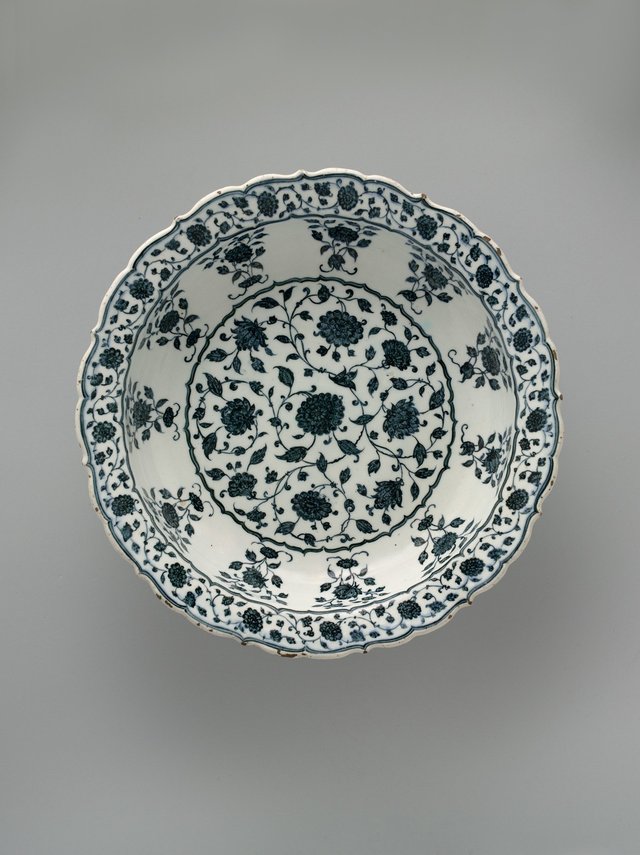
Footed Dish with Foliate Rim in Imitation of Chinese Porcelain
- Maker
- Maker unrecorded
- Date
- ca. 1570–80
- Collection
- The Metropolitan Museum of Art
- Accession
- 66.4.2
- Credit
- Harris Brisbane Dick Fund, 1966
- Rights
- CC0
A dish translates porcelain.
A connection identified by The Met
Read the visual essay