Afterlives / Visual essay
Cloth without a loom.
Can a sculpture remember weaving without being woven?
Read through the records
Unit
Join
Field
The original works remain with their source records. Follow the links below to view them alongside the argument.
A way into this story
Read the work at three scales: unit, join, field.
Unit
An object with a previous use
Start with the named materials. Their former function belongs to the work’s material history; it does not dictate every meaning a viewer will find.
Inspect the evidence ↓Join
Many hands make a surface
The filmed studio account makes collaboration visible. A single artist’s name need not erase the work of assembly.
Inspect the evidence ↓Field
A form that recalls another practice
The catalogue’s textile relationship is a reference to traditions. We have no basis to supply a missing, supposedly original cloth.
Inspect the evidence ↓
01 / Close reading
A bottle cap can become part of a fold.
At a distance, Dusasa II offers a hanging field of folds and colour. The Met’s material record changes that first impression: found aluminum, wire and plastic disks occupy the place where a viewer might expect yarn. Small hard elements make a surface capable of behaving like something soft.
Move closer in the museum’s reproduction and look for the joins. Each small element belongs to a larger field without losing the possibility of being recognized as a worked fragment. The encounter moves between two scales: a broad hanging form and the many connections that hold it together.
02 / Historical account
The title gives the team a place in the work.
The Met reports Anatsui’s explanation of Dusasa as a communal patchwork made by a team. That makes collaboration part of the work’s naming as well as its making. Art21’s later film shows assistants assembling bottle-cap blocks that Anatsui rearranges on the studio floor.
The 2011 film is evidence of that studio practice, not a production diary for the 2007 sculpture. Read it beside the earlier work: a join can carry an individual decision, accumulated manual work and a change made at the scale of the whole composition.
03 / Open question
A reference can remain one strand among several.
The Met places kente among the sculpture’s references, alongside other artistic forms. The resemblance to cloth need not settle the work’s identity. It gives a viewer one way to approach its folds and patterned fields while its materials keep reopening the question.
Try changing your distance from the source image. When do you begin to see the separate elements, and when do they return to a continuous surface? That threshold gives this work its own kind of afterlife: an object from an earlier use remains present inside a new way of seeing.
Keep the identities distinct
Works, people & carriers.
work
El Anatsui, Dusasa II
2007
Met 2008.121; artwork image remains an external reference.
Open the source record ↗tradition
Ghanaian kente traditions
Continuing practice
A plural tradition, not one identified source cloth.
Open the source record ↗workshop
El Anatsui’s studio and assistants
Filmed 2011
The filmed practice postdates the 2007 work.
Open the source record ↗The research stays attached
How we know.
Source verification and prose revised with AI assistance. Independent specialist review remains pending.
Editorial review · 2026-10-17
Separate hard fragments become a flexible field through collective joining.
Checked 2026-10-17 · cloth-without-a-loom.2
Download the research record ↓attributedThe Met relates Dusasa II to Ghanaian kente and several other artistic traditions; it identifies the work’s materials as found aluminum, copper wire and plastic disks.
Relationship: attributed reference
Ghanaian kente traditions El Anatsui, Dusasa II
The limit: The catalogue does not name one source textile. Multiple references should not be reduced to a single origin.
- Dusasa II, 2008.121 ↗
Opening commentary; Artwork Details
documentedArt21’s studio account describes assistants making joined bottle-cap blocks that Anatsui rearranges during composition.
Relationship: catalogue fact
The limit: Filmed in 2011; this supports an account of practice, not a complete reconstruction of Dusasa II’s production.
- El Anatsui: Studio Process ↗
Film description; filmed in Nsukka in 2011, released 20 July 2012
attributedThe Met reports Anatsui’s explanation of Dusasa as a communal patchwork made by a team.
Relationship: acknowledged reference
The limit: The explanation is attributed to the artist through the museum; it does not identify every collaborator on this sculpture.
- Dusasa II, 2008.121 ↗
Opening commentary, third paragraph: artist-attributed title explanation
Source ledger · 2 records
object record · en
Dusasa II, 2008.121 ↗
The Metropolitan Museum of Art
Checked 2026-10-17 · Source text. Relevant institutional record text checked through the research browser; direct scripted requests were rate-limited.
Locate: Opening commentary; Artwork Details
Supports: The 2007 work's materials, title and multiple artistic reference traditions, including Ghanaian kente.
Limit: No particular historical cloth is identified as the source. Courtesy credit does not establish Artologium image permission.
artist account · en
El Anatsui: Studio Process ↗
Art21; interview by Susan Sollins
Checked 2026-10-17 · Source text. Relevant source text and its stated object, date or license fields were inspected; this does not imply independent specialist review.
Locate: Film description; filmed in Nsukka in 2011, released 20 July 2012
Supports: Assistants assemble bottle-cap blocks that Anatsui rearranges during composition.
Limit: The account concerns studio practice; it does not document every stage of Dusasa II's making. No film still is reproduced.
Public life: reach, response, consequence
Reach. The sculpture and later Art21 film offer different public encounters with work and practice. Their audiences are not counted here.
Response. The title explanation is attributed to the artist through the Met; the 2011 account records studio practice.
Consequence. The sources make material reuse and collective making available for study. They do not identify one original kente cloth or measure the sculpture’s social effects.
Versions & corrections
- cloth-without-a-loom.1 · 2026-10-17
First source-checked review edition. Historical claims and original readings are distinguished; image permissions are recorded separately.
- cloth-without-a-loom.2 · 2026-10-17
Checked the artist-attributed meaning of Dusasa and the material record. Reclassified the later studio-process account so it no longer forms an edge from 2011 practice to a 2007 work. Made the join, scale and team central rather than treating kente as a single source cloth.
Historical source assertions, editorial readings and image decisions are separate. A revision changes the research version and regenerates dependent summaries and exports.
Suggest a correction →The story branches
Carry a question forward.
These are editorial reading suggestions. Each investigation makes its own argument.
Follow collective making into another setting.
A workshop travels.
What if the thing passed on is a way of working together?
A documented connection
Read the visual essayFollow collective making into another setting.
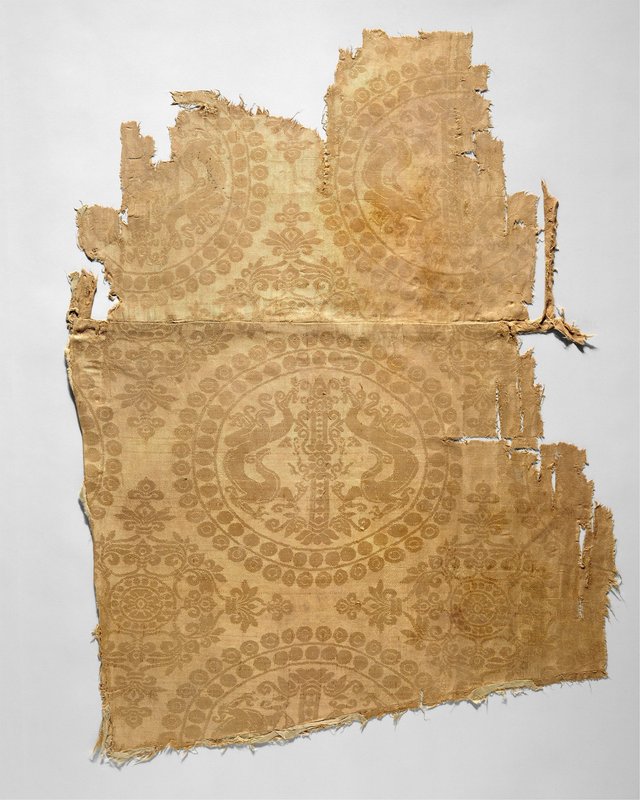
Textile with Pearl Roundels with Dragons
- Maker
- Maker unrecorded
- Date
- late 8th–9th century
- Collection
- The Metropolitan Museum of Art
- Accession
- 1998.147
- Credit
- Purchase, Barbara and William Karatz Gift, 1998
- Rights
- CC0
A border outlives an empire.
A connection attributed in the research
Open the connection study