Technical Material
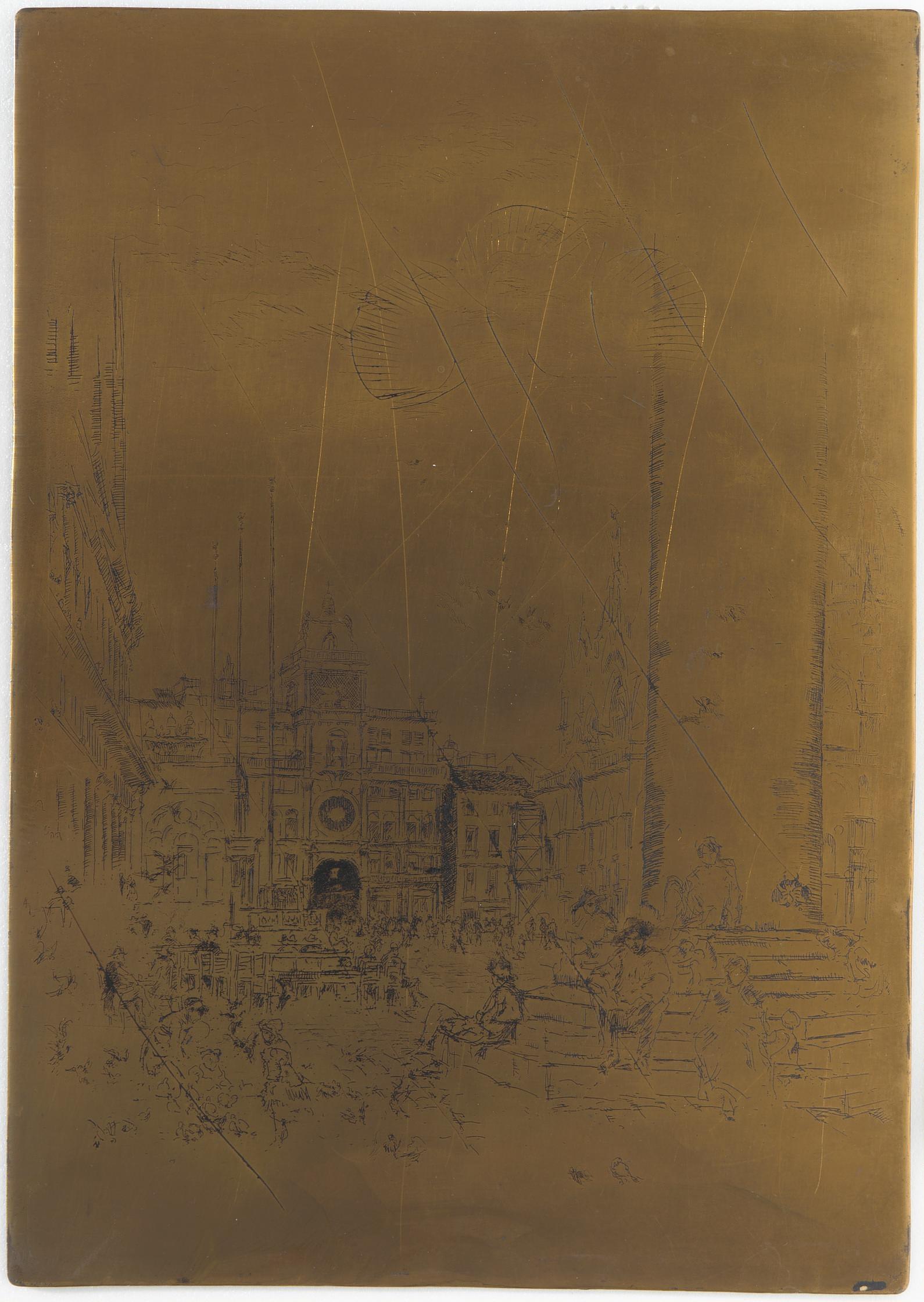
St. James's Street
James McNeill Whistler. 1878. etched and cancelled copper plate. Explore the catalogue record, image rights and documented connections from National Gallery of Art.
A maker across collections.
Whistler: the plate after printing. →Follow the maker / Across collections & investigations
James McNeill Whistler across 3 collections
Each museum’s exact creator wording is preserved on its record. Reconciled maker links group works attributed directly to James McNeill Whistler while keeping workshop, studio, or “after” attributions distinct.
- The Two ShipsNational Museum of Asian Art · 1875 · F1901.195 · Compare side by side →
- Cylindrical jarNational Museum of Asian Art · 1876-1878 · F1907.176 · Compare side by side →
- Amsterdam, from the TolhuisNational Museum of Asian Art · 1863 · F1898.327 · Compare side by side →
- Still lifeNational Museum of Asian Art · 1876 · F1898.415 · Compare side by side →
A record, with reasons
Ways into this work
Open a description to see its meaning and evidence, or follow it into the collection.
Catalogue knowledge
Normalized from the museum’s record.
Technical MaterialObject type
Technical Material is a type of object named in the museum catalogue.
An explicitly supplied catalogue description, normalized conservatively. It does not independently establish attribution, completeness, symbolism or historical influence.
National Gallery of Art supplies “Technical Material” in its object type field. This label was normalized by the documented import rule.
Technical Material
Catalogue: National Gallery of Art. Automated source-field normalization; no independent visual interpretation.
Source normalization checked 2026-10-21 · 2026-10-20.1
Visual observation
Observations of the displayed image.
Following a lineComposition
A line or edge that can be followed through the selected image.
This observation belongs to the selected image; it does not establish the maker's intention.
Two episodes of incision—pictorial drawing and deliberate cancellation—remain visible on the same metal plate.
Visual observation by Artologium on the selected image asset.
Reviewed 2026-10-24 · 2026-10-20.1
Artologium reading
Authored connections, open to interpretation.
RememberCuratorial reading
Recording, remembrance, repetition as memory, and surviving traces.
Age alone is insufficient; the reading must explain what is recorded or remembered.
Editorial reading focusing on the plate's afterlife as a cancelled matrix.
Curatorial interpretation by Artologium; not a museum department or historical category.
Reviewed 2026-10-24 · 2026-10-20.1
InventCuratorial reading
Constructed worlds, experiments, and methods of making something visible.
This reading does not claim historical priority or technological invention.
Editorial reading attending to printmaking matrix and process.
Curatorial interpretation by Artologium; not a museum department or historical category.
Reviewed 2026-10-24 · 2026-10-20.1
These descriptions belong to this object and its selected image. Unlisted features may be unassessed. Editorial observations and readings were developed with AI assistance; they do not establish the maker’s intent.
Keep something. Change the setting.
Follow a connection
A shared description opens a comparison. It does not establish historical influence.
Stay with this work
Let a detail lead you somewhere.
Objects that lived twice ↗
Some museum objects refuse to belong to a single moment. A Roman sardonyx cup is set into twelfth-century silver-gilt; a copper plate is scored to end its edition; a broken tile is rejoined; a woodblock is carved on its reverse. Follow five objects whose surfaces record a second life.
Keep one thing. Change another. ↗
Choose a shared description and inspect the differences the catalogue can support.